
What's in this article
Leaving the hospital with an elderly parent is rarely the clean hand-off it looks like on paper. One minute you’re listening to a nurse list medications and follow-up appointments; the next you’re packing bags, arranging the car, and trying to remember whether the new blood-pressure pill is twice a day or once. Verbal instructions given at the bedside have a way of vanishing the moment you’re focused on getting everyone home safely.
This checklist is the set of questions worth asking before you walk out the door. It is not medical advice. It is a practical way to make sure the information you need actually ends up somewhere you can find it later.
Get the Discharge Plan in Writing
Hospitals generate a discharge summary and a set of patient instructions for every patient who leaves. Those documents exist. The problem is that they are sometimes handed over quickly, explained once, and then disappear into a folder that gets stuffed into a tote bag.
A complete written discharge plan should include:
- A short summary of the reason for the hospital stay and the final diagnosis
- Clear care instructions (wound care, activity limits, diet, etc.)
- A list of medications with dosages and timing
- Scheduled follow-up appointments and which provider to see
- Phone numbers for questions after hours
- Any ordered equipment or home-care services
Ask the discharge planner or the nurse who is discharging your parent, by name: “Can I get the full discharge plan and instructions in writing before we go?” Most hospitals can print or email a copy on the spot. If the paperwork is not ready, ask when it will be and wait for it. Ten extra minutes at the hospital is easier than trying to reconstruct the conversation three days later.
Questions to Ask About Medications
Medication changes are one of the most common sources of problems after discharge. New prescriptions get added, old ones get stopped or adjusted, and the reasons are not always obvious once you’re home.
Ask specifically:
- What medications are new?
- What medications were stopped or changed in dose?
- Why was each change made?
- Is there a written list that shows the name, dose, timing, and what each medicine is for?
- Are there any special instructions (take with food, avoid alcohol, do not crush, etc.)?
Medication errors at the point of discharge are common enough that hospitals now track them as a quality measure. Having a clean, written list that you can check against the bottles at home reduces the chance that something important gets missed or doubled.
Questions to Ask About Equipment and Home Care
Not every piece of equipment that appears in a hospital room is needed at home, and not every needed item is automatically ordered.
Clarify:
- Which items are actually required (walker, wheelchair, oxygen, wound-care supplies, hospital bed, etc.) versus optional or temporary?
- Who is responsible for ordering and delivering them?
- What is covered by Medicare or the secondary insurance, and what will be out of pocket?
- Have any home-health or follow-up nursing visits already been arranged, and by which agency?
If home care has been ordered, get the name of the agency and the expected start date before you leave. If nothing has been arranged and you think it should be, ask the case manager or discharge planner to make the referral while you are still there.
Know What’s Normal and What’s an Emergency
This is the question many families wish they had asked more clearly. Before you leave, ask the doctor or nurse practitioner directly:
“What symptoms mean I should call the office, and what symptoms mean I should call 911 or go back to the emergency department?”
Ask about the categories that apply to your parent’s situation — pain, fever, confusion or sudden change in alertness, shortness of breath, swelling, bleeding, wound appearance, or anything else the care team is watching. Write the answers down in the same place as the rest of the discharge information. The goal is not to create alarm; it is to replace guesswork with the care team’s actual thresholds.
This is general organizational information, not medical advice, and does not replace guidance from your own care team.
Want this as a free, printable page?
Tell us where to send it and we’ll email it right over — no spam, unsubscribe anytime.
Put the Answers Somewhere You’ll Actually Find Them Again
Hospital paperwork has a short lifespan. It gets folded into a bag, mixed with discharge prescriptions, and often ends up in a drawer that no one opens for weeks. When a question comes up at 10 p.m. on a Tuesday — Is this dose correct? Was the oxygen supposed to be continuous? — you need the answers in one place that is easy to find.
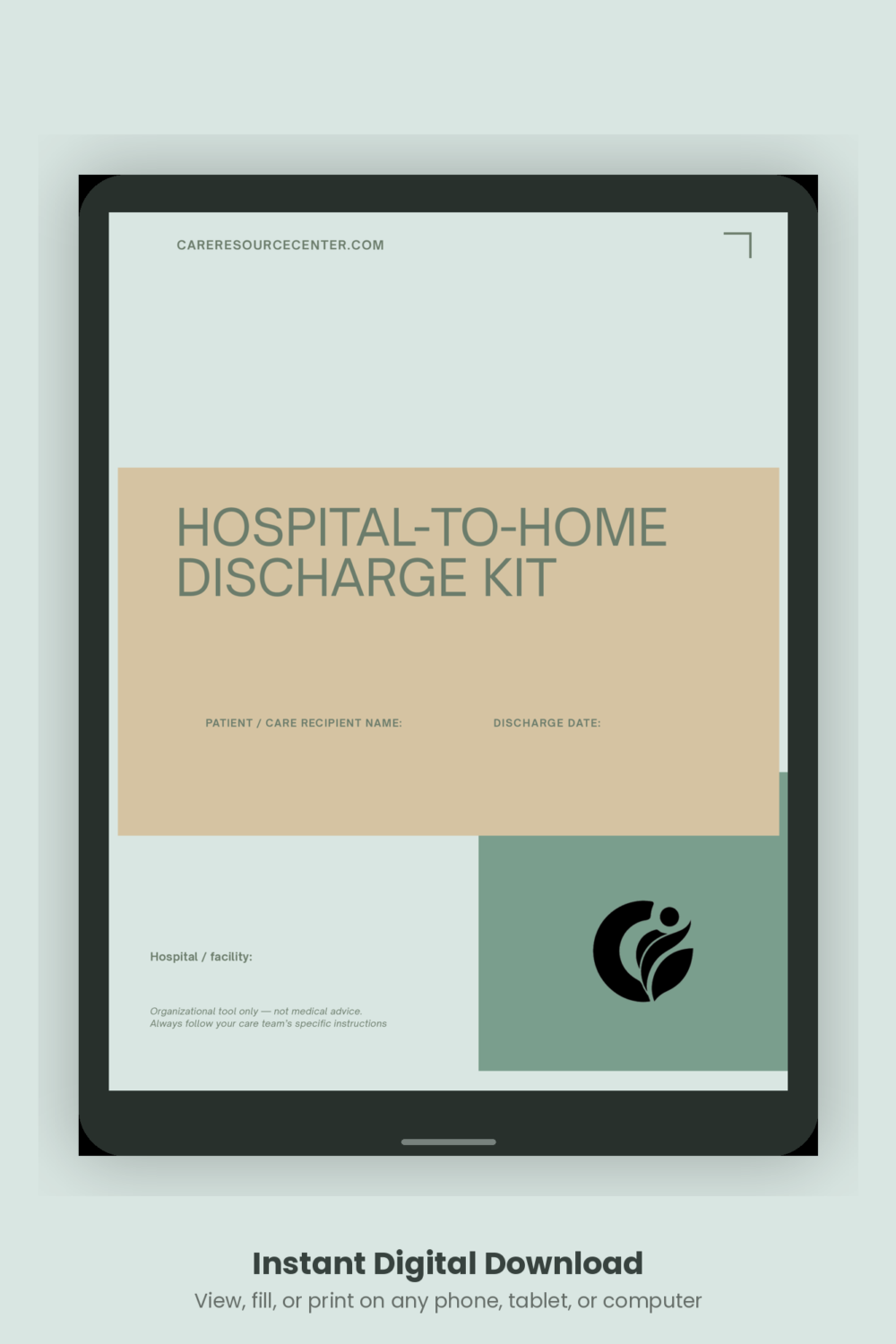
That is exactly why we made the Hospital-to-Home Discharge Kit: a simple, durable place to keep the written discharge plan, the medication list, the equipment notes, the warning-sign thresholds, and the follow-up appointments together. No more hunting through bags or trying to reconstruct a conversation from memory.
Hospital-to-Home Discharge Kit
This 12-page printable kit gives you one place to write down what the care team tells you, track every medication change, and know exactly when a symptom means it’s time to call.
If you only take one thing from this checklist, take this: get the plan in writing, ask the medication and equipment questions while the team is still in the room, and put the answers somewhere you will still be able to find them a week later.
Question: How far in advance should I start asking about discharge?
Answer: As soon as your parent is admitted, if possible. Discharge planning works best when it starts early, not in the last hour before you leave.
Question: What if the hospital won’t give me anything in writing?
Answer: You can ask specifically for a copy of the discharge summary and instructions — this is standard and hospitals are generally able to provide it. If you’re told it’s not available, ask to speak with a case manager or patient advocate.
Question: Is this checklist a substitute for what my parent’s doctor tells me?
Answer: No. This is a way to organize and remember the instructions you’re given — always follow your parent’s actual care team over anything you read here.
Question: What if my parent is discharged to a rehab facility instead of home?
Answer: Many of the same questions apply — medications, warning signs, and follow-up care — but ask the facility staff directly, since day-to-day care will be theirs rather than yours at first.